Google Ads for Sandwich Panels: From One Form a Week to 36 Enquiries

Since 9 September 2026 we have been running a Google Ads campaign for B100, a Croatian company that sells roof and wall sandwich panels. The ads lead to sendvic-paneli.hr, a website we also built. The campaign has been live for a little over a month, and the numbers are clear enough to share.
Before and after
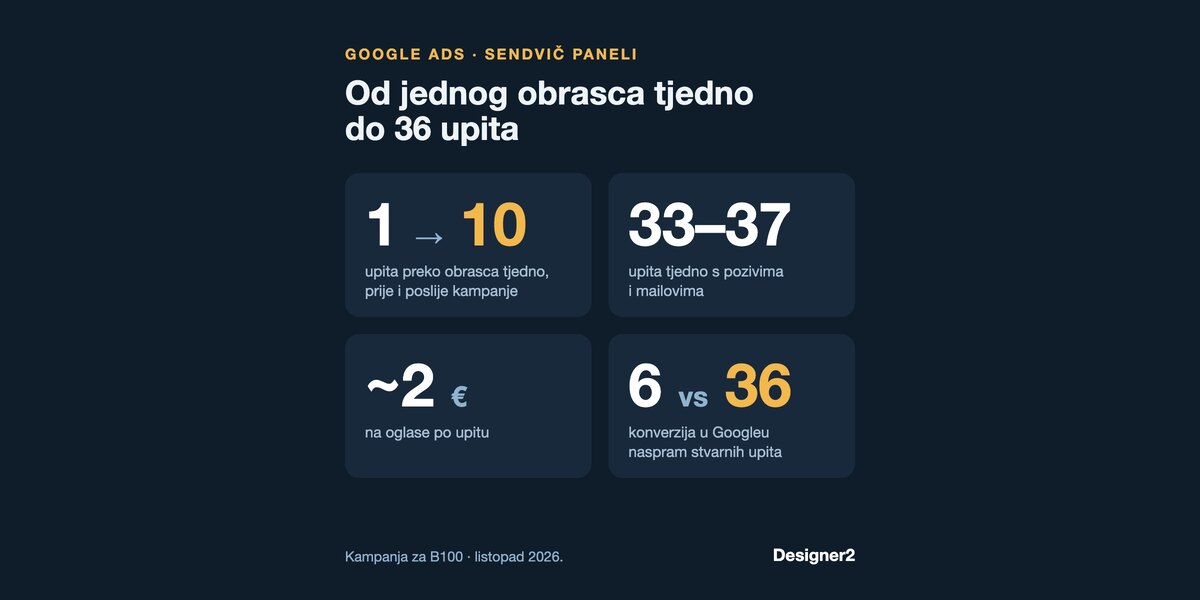
In the 48 days before the campaign, the contact form on the website brought in six enquiries. That is roughly one a week. Today the form alone brings in about ten enquiries a week.
The form is not the main route to a sale, though. Most customers call or send an email. Counting calls, forms and emails together, the week of 2–8 October brought 36 to 37 enquiries, and the week of 9–15 October brought 33.
- Form enquiries: about one a week before the campaign, about ten now.
- All enquiries: 36–37 and 33 in two full weeks of October (calls, forms and emails).
- Cost per enquiry: about €2.05 and €2.26 in ad spend.
- Cost per click: the weekly average fell from €0.31 to €0.21.
Three things made the biggest difference.
1. Ads by thickness and purpose
Many people don't just search for “sandwich panels”. They type “sandwich panels 3 cm price” or look for roof panels. A buyer like that usually knows what they need. So we split the ads into groups by purpose and thickness: roof panels, wall and façade panels, halls and warehouses, price and quote, plus separate groups for 3, 5, 8 and 10 cm panels.
Each group has its own ads, so the ad answers exactly what the buyer typed. Ads for roof panels lead to the roof panels page, and ads for wall panels lead to the wall panels page. Both pages also list prices by thickness.
2. We count real enquiries, not just Google conversions
In the week of 2–8 October, Google recorded six conversions. There were 36 to 37 real enquiries. The gap is big because Google doesn't see most phone calls, or emails that customers send straight from their own inbox.
That is why B100 regularly tells us how many calls, forms and emails came in. This way we know the real cost of an enquiry. If we looked only at Google's numbers, that week we would have seen about six times fewer enquiries than there really were, and it would be easy to make the wrong decisions.
3. We check daily and change things for a reason
We monitor the campaign every day, but we don't touch it without a reason. The big changes were made in the first month. Since then we mostly watch the numbers and change things only when the data justifies it.
In the week of 2–8 October a click cost €0.31 on average, and in the week of 9–15 October €0.21. For almost the same spend we got 349 clicks instead of 240.
Not every day is a good day
Some days bring no enquiries at all, others bring ten. One weak day doesn't mean the campaign isn't working, and one great day doesn't mean the job is done. That is why we make decisions based on the weekly average, not on a single day.
What any business can take from this
- An ad should answer what the buyer typed, in their own words.
- The page the ad leads to should answer the same question.
- Count every enquiry, not only the ones Google can see.
- Look at weeks, not single days.
See the website the ads lead to at sendvic-paneli.hr, and read how we built it in our portfolio post.
How much does one enquiry from your website cost your business today? If you don't know, or it feels like too much, get in touch. We run Google Ads campaigns and build websites that bring in enquiries.